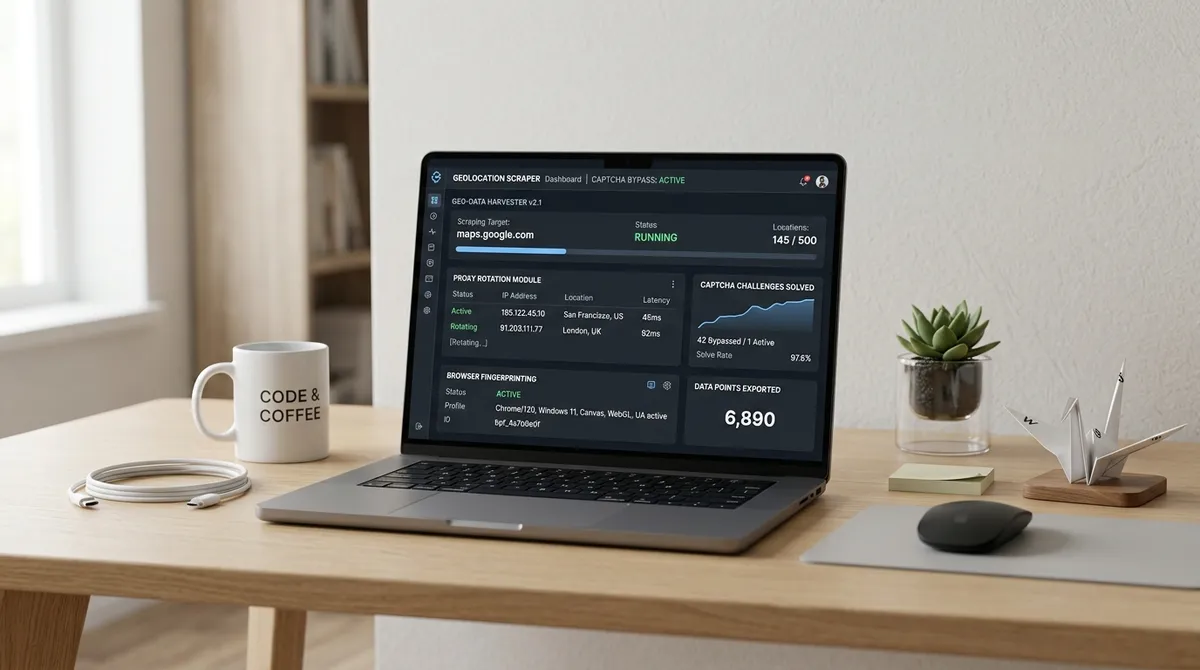

TL;DR: Google Maps API pricing overhauled on March 1, 2025 — the old $200 monthly credit is gone, replaced by stingy per-SKU free caps. Nearby Search now costs $32 per 1,000 calls. OpenStreetMap's Nominatim (free, 1 req/sec), Foursquare Places (500 free Pro calls/mo), and newer free APIs like BizData (no key, no limits) offer real alternatives. Here's which one fits your budget and your use case, and when paying still beats free.
I have a theory about APIs. They follow the same lifecycle as a frog in a slowly boiling pot of water — except the frog knows exactly what's happening, checks the water temperature daily, and still somehow convinces itself, "Eh, it'll be fine this month."
I was that frog. Maybe you're that frog too.
Three years ago I needed business data from Google Maps for a client project. I signed up for the Google Maps Platform, got my $200 monthly credit, and everything was great. I ran a few thousand API calls, the credit soaked them up, and my monthly bill was a big fat zero. I felt like I'd hacked the system. I told friends. I bought a domain with the money I was "saving."
Then March 1, 2025, happened. Google didn't just turn up the heat — they replaced the entire pot.
Free API for Google Maps
Let me walk you through the moment the Google Maps free ride ended, because it hit like a plot twist nobody asked for.
On March 1, 2025, Google replaced the $200 monthly recurring credit with per-SKU free usage caps (Google for Developers, March 2025). Sounds like a naming change, right? It's not. It's the difference between having a single bucket that covers all your spills and having fifty tiny cups that each only catch one specific kind of spill.
Under the old system, all your API calls fed from one $200 pool. You used Maps load, Places search, Geocoding — it all drew from the same bank account. Under the new system, each product family has its own tiny allowance. Essentials SKUs get 10,000 free calls per month. Pro SKUs get 5,000. Enterprise gets 1,000 (Google for Developers, Pricing Categories). And here's the trap: those cups don't share. If you drain your Places Nearby Search cap (10,000 calls) you start paying $32 per 1,000 calls for the next tier (Google for Developers, Price List) — even if you haven't touched your Geocoding or Dynamic Maps allowances at all.
A 5,000-business extraction that once cost you nothing under the $200 credit now runs around $245, assuming you do the math right and stay inside your caps (Scrap.io, 2026). Go over, and the Places Nearby Search SKU alone burns through cash at $32 per thousand calls. Your old $200 credit covered roughly 6,250 Nearby Searches per month. Today, the same 10,000 free calls cap covers you, and then the meter starts ticking.
This is the moment most people start searching for a "free API for Google Maps." They don't want to steal anything — they just want yesterday's economics back. And the good news? They exist. They're just not called Google anymore.
Google Maps Free API
Here's where I tell you about the scrappy, open-source underdogs that do 80% of what Google Maps API does for 0% of the price.
OpenStreetMap's Nominatim is the oldest and most battle-tested free alternative. It's the geocoding service powering the search bar on openstreetmap.org, and it doesn't require an API key — just a valid HTTP Referer or User-Agent header identifying your application (OSMF Nominatim Usage Policy). The rules are simple: no more than 1 request per second, cache your results, and provide proper attribution under the ODbL license. Need 36,000 geocodes a day? Technically possible, if you're patient. Need 50,000 in an hour? You'll hit the rate limit faster than you can say "donated server capacity."
For business data extraction beyond geocoding, the Overpass API (also running on OSM data) lets you query points of interest by category and location. Tools like the free Google Maps Business Data Scraper on Apify wrap Overpass into a usable API without requiring you to learn Overpass QL (Apify, Google Maps Business Data Scraper Free). Global coverage, no API key, and you get names, addresses, phone numbers, and coordinates.
The catch with OpenStreetMap? Data quality varies dramatically by region. Coverage in Europe — especially Scandinavia, Germany, and France — is excellent, often rivaling Google. In developing markets and rural areas, it's spottier (BizData API). And you won't get review text, photos, or real-time opening hours. If your use case is "I need a list of plumbers in London with phone numbers," OpenStreetMap delivers for free. If your use case is "I need every review ever written about every plumber in London," you're back in paid territory.
Foursquare Places API sits in the middle ground. It still has a free tier — 500 Pro calls per month as of June 2026, down from the previous 10,000 (Foursquare Pricing). Beyond that, Pro endpoints run $15 per 1,000 calls. It covers 100 million-plus points of interest across 200 countries, with better structured data than OpenStreetMap but at a fraction of Google's cost. The attribution requirement — "Powered by Foursquare" wherever Places data appears — is the trade-off.
And then there's the new kid. BizData API launched as a completely free REST API powered by OpenStreetMap, with no API key, no signup, and no rate limits (BizData API). It returns names, addresses, phone numbers, websites, emails, and coordinates for 37 business categories globally. It even has a built-in MCP server for AI tool integration. I'm not sure how they're paying the server bills, and neither should you be, but for testing and small-scale projects, it's a genuinely useful option.
Free Alternative to Google Maps API
Let me give you the comparison you actually came here for — which free alternative fits your specific situation, not just which one has the best marketing copy.
| Solution | Free Tier | Pricing After Free Tier | Best For | Data Quality | Key Limitation |
|---|---|---|---|---|---|
| Google Maps API | 10K calls/mo (Essentials) | $32/1K (Nearby Search) | Consumer apps, live lookups | Excellent everywhere | Expensive at scale |
| Nominatim (OpenStreetMap) | Unlimited (1 req/sec) | Self-hosted at ~$100/mo server cost | Geocoding, address lookup | Excellent in Europe, variable elsewhere | No reviews, photos, or real-time data |
| Foursquare Places | 500 Pro calls/mo | $15/1K (Pro), $18.75/1K (Premium) | Place search with structured metadata | 100M+ POIs, 200+ countries | Attribution required, premium endpoints costly |
| Overpass API (OSM) | Unlimited (generous limits) | Self-hosted option | Business POI extraction by category | Strong in Europe, ODbL license | Requires Overpass QL or wrapper tool |
| BizData API | Completely free | None currently announced | Small-scale testing, prototyping | OSM-sourced, variable by region | New/unproven, no SLA |
| Geoapify | 3K requests/day | $0.40/1K | Geocoding, routing, places | OSM + proprietary blend | Rate-limited free tier |
The table tells a story. If you're doing geocoding — turning addresses into coordinates — Nominatim is genuinely free forever if you stay under 1 req/sec. If you're extracting business listings at moderate volume, Foursquare's $15/1K after 500 free calls beats Google's $32/1K by more than half. If you're building a lead generation workflow that needs to pull thousands of businesses every week, none of these pure-API approaches match the economics of a flat-rate extraction tool.
Here's an extrapolation that might sting: the free-tier volume gap matters more than any per-call price difference. Google gives you 10,000 free calls on Essentials SKUs. Foursquare gives you 500. But Google's Nearby Search costs $32 per 1K, and Foursquare's Pro endpoints cost $15. So once you exceed free caps, Foursquare is cheaper — unless your workflow needs Premium endpoints (Tips, Photos), which start at $18.75/1K with no free tier at all.
The real insight is that "free API" is a misleading frame. What you're actually optimizing for is which pricing curve matches your volume. For under 500 calls a month, Foursquare is effectively free. For 10,000 to 50,000 calls a month, OpenStreetMap-based solutions or flat-rate paid tools outperform both Google and Foursquare on total cost. Above 50,000? The math tilts hard toward dedicated scraping tools that don't meter every request.
None of these will serve you well if Google's anti-bot systems are flagging your IP. Inside every free API pitch is a conversation about bypassing Google Maps CAPTCHA — because if you can't get past the gate, no amount of per-call savings matters.
What You Actually Save (And What You Lose)
I'm going to give you a number that surprised me. A mid-range extraction of 5,000 business records through the Google Maps API — Places Nearby Search + Place Details — costs roughly $245 in API fees in 2026, and that doesn't include email addresses or social profiles (Scrap.io, Cost Calculator). The same data through OpenStreetMap's Overpass API: $0 but only 60-70% of the fields. Through Foursquare: about $67.50 after the 500 free calls. Through a flat-rate scraping tool: $49 to $59.
The curve flips hard at volume:
| Monthly Records | Google Maps API | OpenStreetMap | Foursquare | Flat-Rate Tool |
|---|---|---|---|---|
| 500 | ~$0 (within caps) | $0 | $0 (within 500 free) | $0 (free tier) |
| 5,000 | ~$245 | $0 | ~$67.50 | ~$49 |
| 20,000 | ~$3,620 | $0 (self-hosted ~$100/mo) | ~$292.50 | ~$99 |
| 100,000 | ~$11,600 | $0-$200/mo | ~$1,492.50 | ~$499 |
| 500,000 | ~$56,000+ | $0-$400/mo | ~$7,492.50 | Custom |
The OpenStreetMap row looks unreal, I know. But it's real — the cost is zero at the API level, and only your infrastructure (self-hosting Nominatim or paying for a managed OSM provider) adds expense. A medium-sized server can handle about 10 requests per second with a full Nominatim install (Nominatim Github Discussion). That's 864,000 geocoding requests daily for the cost of a $50/month VPS.
What you lose: review text, real-time data, photos, phone numbers for every business (OSM coverage on phone numbers is about 40-50% in most regions), and any guarantee of data freshness. Google refreshes its business data more aggressively than the OSM community does. If your lead generation depends on calling businesses that still exist and still answer, that gap matters.
What you gain: the ability to scale data extraction without your monthly bill growing linearly with every record. The flat-rate model — where you pay $49 whether you pull 1 record or 10,000 — is structurally superior for anyone doing regular outbound campaigns. You're not paying per API call; you're paying for the capability.
And if you're worried about export formatting — because raw API output is rarely CRM-ready — you already know the pain of Google Maps data export to CSV issues. Free APIs return JSON; turning that into a usable spreadsheet file with deduplicated contacts is a whole separate project.
FAQ
Is the Google Maps API free in 2026? Partially. Since March 1, 2025, each SKU has a free monthly cap — 10,000 for Essentials, 5,000 for Pro, 1,000 for Enterprise (Google for Developers, March 2025 Changes). The old $200 pooled monthly credit is gone. New accounts get a one-time $300 trial credit.
What is the cheapest alternative to Google Maps API for geocoding? OpenStreetMap's Nominatim is free with a 1 request/second rate limit and no API key required. For higher volumes, self-hosting Nominatim costs roughly $50-$100/month in server infrastructure. Geoapify offers 3,000 free requests per day.
Is there a completely free Places API with no credit card required? OpenStreetMap-based APIs like Nominatim and Overpass require no key at all — just a custom User-Agent header. Foursquare's free tier requires a Foursquare account. Google requires a billing account setup but provides free usage caps.
Does Foursquare still have a free tier in 2026? Yes, but it was reduced. As of June 1, 2026, Foursquare offers 500 free Pro endpoint calls per month, down from the previous 10,000 (Foursquare, Upcoming Changes). Premium endpoints (Photos, Tips) have no free tier.
Can I use OpenStreetMap data for commercial lead generation? Yes. OpenStreetMap data is licensed under the ODbL, which permits commercial use with attribution. You must credit "© OpenStreetMap contributors" and share-alike if you redistribute the raw dataset (OSMF License). Standard lead generation — pulling data for your own CRM — doesn't trigger the share-alike requirement.
How much does the Google Maps API cost for 10,000 business searches? Places Nearby Search at $32/1K with 10,000 free calls = roughly $0 if you stay within the free cap. For 20,000 calls (10,000 paid), the cost is about $320. Adding Place Details ($17/1K) for each result doubles the cost. A realistic 5,000-business extraction runs ~$245.
What fields does OpenStreetMap have that Google doesn't? OpenStreetMap often includes machine-readable opening hours — structured in the OSM format — that Google doesn't expose through its API. OSM also includes wheelchair access, wheelchair accessibility attributes, and community-sourced tags that official datasets don't capture.
When does paying for data make more sense than free APIs? When you need data at scale (5,000+ records/month), want email addresses included, need reliable anti-blocking infrastructure, or need CRM-ready output without building a data pipeline. The hidden cost of "free" APIs is your time spent cleaning, deduplicating, and formatting the data. Flat-rate tools that include those features typically start around $49/month.
The Bottom Line
I started this piece saying the frog knows he's in hot water and stays anyway. I think the real reason is inertia and the fear that switching will break something. But here's the truth that research makes undeniable: the free API for Google Maps you're looking for doesn't come from Google. It comes from OpenStreetMap, from Foursquare's more reasonable pricing curve, from newer projects like BizData, and from flat-rate extraction tools that simply don't charge per record.
The smartest move isn't picking "free" over "paid" — it's matching your pricing model to your volume curve. Under 500 calls a month? Foursquare's free tier or Nominatim has you covered. Between 1,000 and 10,000? OpenStreetMap drops your cost to near zero. Over 10,000 records monthly? The savings from ditching per-request billing altogether — whether via OSM self-hosting or a flat-rate tool — hit 90% or more compared to the Maps API.
Stop optimizing the price per request. Start optimizing the price per outcome. Your accountant will thank you.
Ready to pull leads at a fraction of the API cost? See how LeadsAgent's flat-rate extraction stacks up — try it free at leadsAgent.io/download. No credit card, no per-call meter, just a prompt and a spreadsheet.
For agencies running multiple client campaigns, the gap between per-call billing and flat-rate pricing only widens. Download LeadsAgent and see how much you're overpaying for data you could be extracting at a fixed monthly cost.