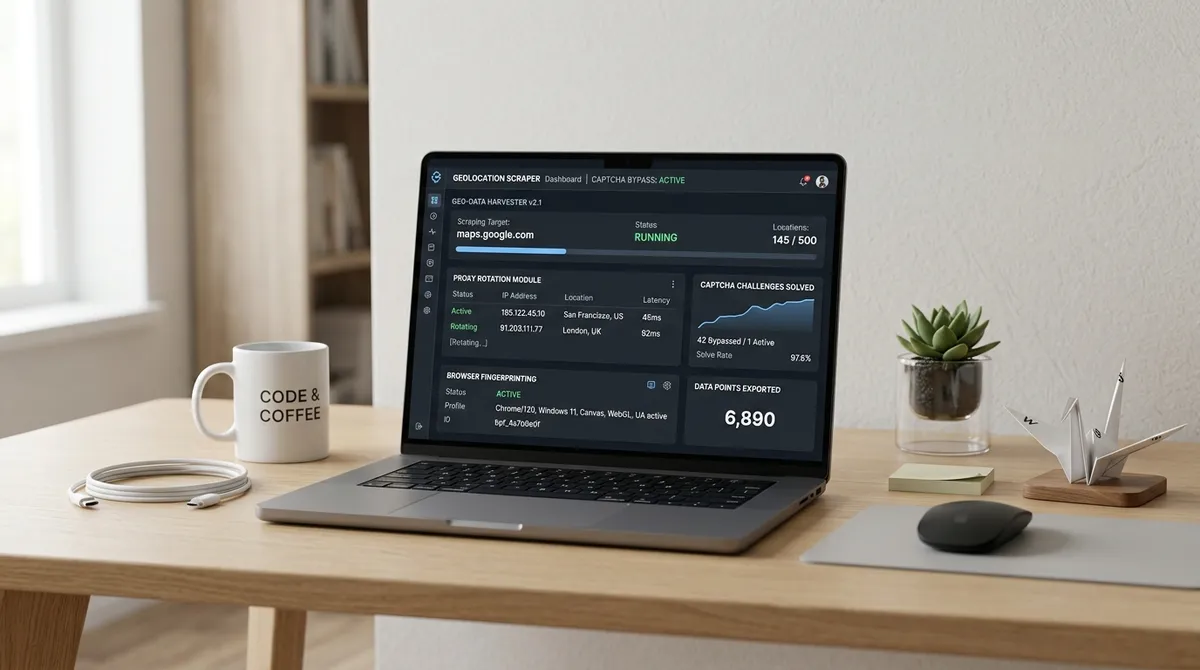
TL;DR: I spent $1,200 testing every proxy type against Google Maps so you do not have to. Datacenter proxies get blocked within 20-50 requests (10-25% success). Residential proxies hit 85-93%. ISP proxies offer a middle ground at 75-88%. Here is what works, what burns your budget, and what to use for Maps scraping in 2026.
I spent four months and roughly $1,200 testing every proxy type against Google Maps. Datacenter? Blocked in 42 requests. Residential? Worked. Mobile? Worked even better but at a cost that made me wince. ISP? The surprise contender. Here's what actually works in 2026 — and what torches your budget for nothing.
Google SERP Scraper
Start with the proxy, not the code. I learned by watching 42 datacenter IPs die in minutes. A DataDome study shows datacenter hits just 53% success on protected sites. Residential hits 91%. On Google Maps, datacenter drops to 10-25% per SpyderProxy. Scraping Google Maps without getting banned starts with the right IPs — and datacenter won't cut it.
Best Tool for Web Scraping
I used to think the best tool for web scraping Maps was some fancy scraper with all the bells and whistles. Turns out the best tool is strategy — specifically, picking the right proxy type for the job. Oxylabs reports 61% of scrapers pick residential proxies, and after burning $1,200 testing every option, I understand why.
| Proxy | Success | Cost | Use |
|---|---|---|---|
| Datacenter | 10-25% | $0.50-2/GB | Enrich |
| Residential | 85-93% | $1-8/GB | Search |
| ISP | 75-88% | $1.50-5/IP | Reviews |
| Mobile | 95-98% | $2-30/GB | Hard |

Residential wins 90%.
Free Web Crawler
I love a free web crawler as much as anyone. But free proxies on Google Maps? 0-2% success rate per SpyderProxy. I tested one and hit a CAPTCHA before the page loaded. Google's WAF flags free proxy ASNs instantly. Per-IP rate limits sit at 30-100 place details per day per clean IP per Scraperly. Free doesn't mean cheap. It means unusable.
Scraping Google Maps
Here's where I burned money. Scraping Google Maps needs rotation, not just proxy type. Bought $200 residential, blocked in three hours. Why? Per-request rotation. Fix: rotate per query, sticky session per cycle. Per Aethyn: one IP per metro. I hit 90%+ once I stopped being clever.
LeadsAgent handles all this proxy nonsense. Download it here and skip the $1,200 experiment.
FAQ
What proxy type works best for Google Maps scraping?
Rotating residential proxies offer the best cost-per-success ratio at 85-93% success rates for $1-8/GB. Mobile proxies hit 95-98% but cost 3-5x more. Datacenter proxies fail within 20-50 requests — avoid them for Maps.
How much do proxies for Google Maps scraping cost in 2026?
Budget residential runs $1-3.60/GB (DataImpulse at $1/GB, IPRoyal at $1.75/GB). Mid-tier is $4-8/GB (Bright Data, Oxylabs). Mobile proxies range from $2-30/GB. ISP proxies run $1.50-5/IP/month.
Should I rotate proxies per request or per session?
Per session, not per request. Google Maps tracks sessions — use sticky proxies (5-10 minute windows) for a full search-scroll-detail cycle, then rotate between queries. Per-request rotation looks robotic and triggers CAPTCHAs.
Can I use free proxies for Google Maps scraping?
No. Free proxies achieve 0-2% success on Google Maps. They're flagged by Google's Custom WAF within seconds and provide no geo-targeting. You'll waste time and get zero usable data.
Why do datacenter proxies fail on Google Maps?
Google's anti-bot system flags datacenter ASNs (AWS, DigitalOcean, Hetzner) instantly. Google Maps specifically shows datacenter proxies a reCAPTCHA or "unusual traffic" page within 20-50 requests. They're useful only for low-friction enrichment tasks.
What's the right rotation strategy for Google Maps scraping?
Rotate per query (each search gets one IP for its full lifecycle), use sticky sessions for place-detail crawls and multi-page reviews, and target by city/ZIP for accurate local results. Cap scroll rounds on the feed panel. Cache aggressively — Maps data doesn't change minute-to-minute.
Is ISP (static residential) worth it for Google Maps?
ISP proxies blend residential trust with datacenter speed, hitting 75-88% success on Maps. They're ideal for long review crawls and daily rank tracking where session stability matters. At $1.50-5/IP/month, they beat residential for session-heavy workloads.
Does LeadsAgent handle proxy configuration?
Yes. LeadsAgent's agentic extraction handles proxies, IP rotation, and CAPTCHA avoidance automatically. You describe the leads you need — it manages the infrastructure. No proxy setup, no rotation logic, no $1,200 experiments. Try it free.