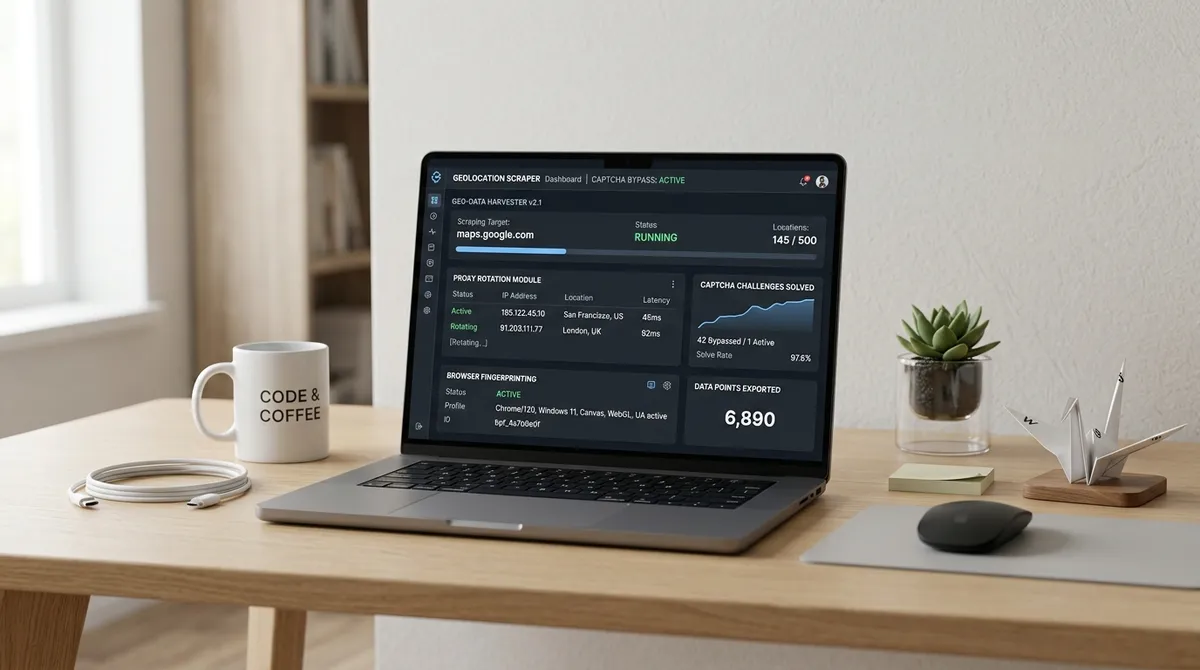

TL;DR: Google processes 8.5 billion searches daily and its anti-bot stack fingerprints your TLS handshake, header order, mouse movements, and IP type before you see a single result. With datacenter IPs you survive 10–50 requests; with residential proxies, stealth browser config, exponential backoff, and grid-based scraping you can collect thousands of listings per day without ever triggering a CAPTCHA.
Web Scraping Google Search Results
Eight-point-five billion queries a day. That is how many searches Google processes, and every single one passes through a detection stack that checks your TLS handshake, header ordering, and IP reputation before serving a single pixel (Scraperly). Here is what hurts: datacenter IPs get flagged before they finish their first request. Independent benchmarks put datacenter success on Google at 62.4% — versus 92.8% for residential and 96.2% for mobile 4G (DataResearchTools). The gap is not about speed; it is about ASN reputation. Hosting providers advertise themselves; ISPs blend in. For the full deep-dive on staying under Google's radar, check our guide on scraping Google search results without getting blocked.
Scrape Data from Website
Here is a table I wish someone had shown me six months ago. It compares the four routes to Google Maps data and what each actually costs you:
| Approach | Cost per 1,000 listings | Block rate | Data freshness | Hair-tearing level |
|---|---|---|---|---|
| Google Places API (New) | $17–$32 (Google pricing) | 0% (authorized) | Cached, often stale | 1/10 — just expensive |
| DIY Playwright + residential proxies | $0.50–$2 (proxy bandwidth) | 15–25% | Real-time | 8/10 — selectors break monthly |
| Managed SERP API | $3–$10 | ~0% from your side | Real-time | 2/10 — they handle the mess |
| Headless browser + datacenter IPs | ~$0.10 (will fail) | 90–98% | None (blocked immediately) | 11/10 — infinite debugging |
The core loop is simple in theory: Playwright or Puppeteer through a rotating residential proxy, scrolling div[role='feed'] until Google shows "You have reached the end of the list." Dedupe on place_id — never on business name, because 47 "Starbucks" entries across one city are not 47 duplicates (Aethyn).
Scraping Google Maps
Three detection layers, and they stack. Google Custom WAF reads your TLS fingerprint and checks it against known browser signatures. reCAPTCHA v3 scores your mouse movements, scrolling rhythm, and request timing — invisible but relentless. IP rate limiting kicks in above 10 requests per minute per IP (Scraperly). The stealth checklist that survives all three: residential proxy rotation, randomized 2–5 second delays, --disable-blink-features=AutomationControlled, and consistent headers matching a real Chrome profile. Our guide on bypassing CAPTCHA without getting blocked walks through the exact fixes I use.
Online Scraping
Here is the 200-result problem: Google hard-caps every search query at about 200 listings. And 200 is not enough for a lead gen campaign covering a metro. The fix is the grid method — divide your target area into 1–2 km cells and scrape each one independently (Aethyn). A metro sweep might hit 50–200 cells, each returning up to 200 results, for a theoretical max of 40,000 listings. Use exponential backoff before marking failures — if your feed stops growing before the sentinel, it is a soft throttle, not the end. Cache results for 24–48 hours because Maps data does not churn minute-to-minute.
If all of this sounds like a second job you did not sign up for, try LeadsAgent free at leadsAgent.io/download. It handles Maps search, website visits, email extraction, and spreadsheet building from one plain-English prompt. No proxies. No CAPTCHA debugging. Just leads.
FAQ
Is scraping Google Maps legal? Scraping publicly visible business data (name, address, phone, rating) while logged out generally falls within the hiQ v. LinkedIn safe harbor. Google's ToS prohibits automated access though. Stay logged out, do not bypass technical controls, and consult a lawyer for commercial scale.
How many requests can I send before getting blocked? With datacenter IPs: 10–50 requests. With residential proxies and proper pacing: 100–300 per hour before CAPTCHAs appear. The safe long-term rate is 30–100 place details per day per IP.
Do I need a headless browser?
Yes. Google Maps is a JavaScript SPA that lazy-loads every result. Sending requests.get() returns a JavaScript bundle, not business listings. Playwright or Puppeteer through a residential proxy with stealth patches is the minimum viable setup.
What proxies work for Google Maps? Rotating residential proxies (85–93% success rate) offer the best cost-per-result. Mobile 4G/5G proxies hit 95–98% but cost 3–5x more. Datacenter proxies are unusable at 10–25% success (DataResearchTools).
How do I bypass the 200-result limit per search? Grid-based scraping: divide your target area into 1–2 km cells and scrape each independently. A metro at 200 cells × 200 results = up to 40,000 listings.
What is the most common mistake in Maps scraping?
Scrolling the browser window instead of the div[role='feed'] panel. The results live in that side panel — scrolling the window captures the first dozen only. You also must scroll until Google shows "You have reached the end of the list."
Should I use the official Places API instead? If you need under 60 results per query and have budget ($17–$32/1k requests), it is clean and zero-maintenance. If you need thousands of listings per city with real-time data, scraping is 10x cheaper.
Can I run this indefinitely without getting blocked? Yes — with residential proxy rotation, sticky sessions per query, randomized 2–5 second delays, stealth browser patches, and horizontal scaling. Google blocks poorly-configured scrapers, not scraping itself.
Stop maintaining a Playwright config that breaks every time Google sneezes. LeadsAgent handles the entire pipeline — Maps search, website visits, verification, and spreadsheet output — in one no-code flow. Start free, no credit card needed.